A six-legged butler you can take apart before he exists.
I am building Rex, a hexapod whose brain already answers in 1.3 seconds on my Mac, and whose body is 26 printed parts that have not met a printer yet.
Take him apart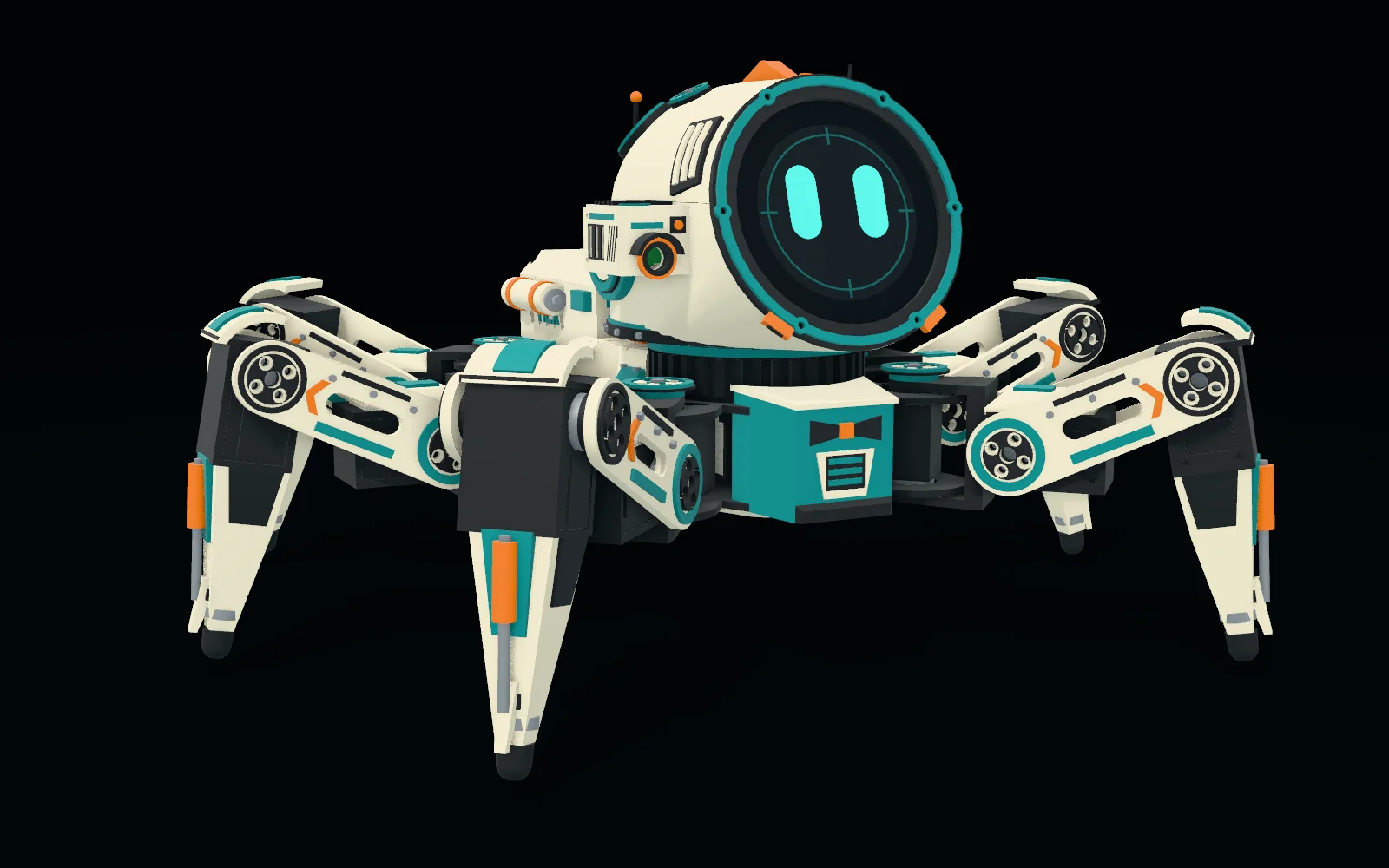
The teardown
Sixteen steps, 312 screws, every part the size it will print.
The page builds him in the order I will: top plate upside down first, the dome last. It weighs the bench as it goes, and an X-ray clears the shells so you can see the 19 servos.
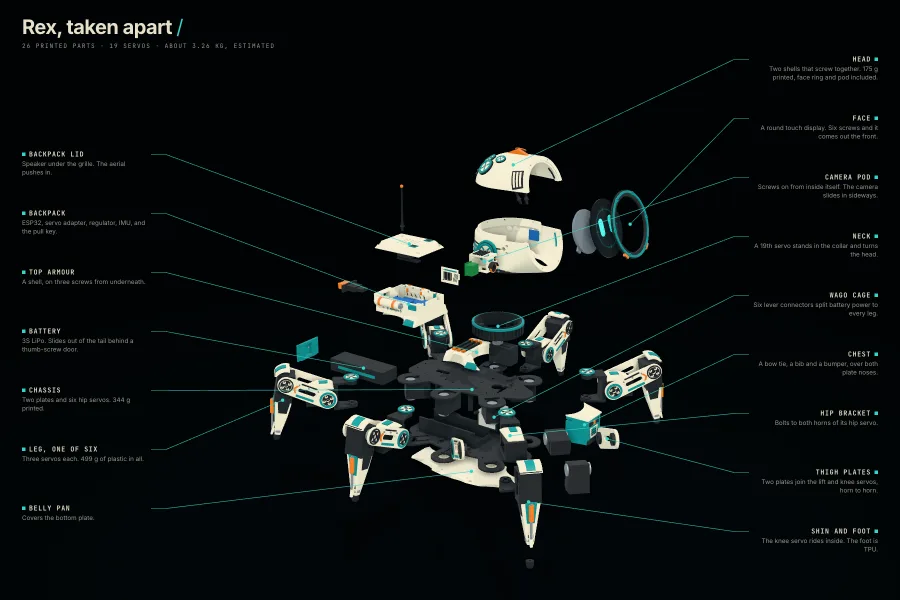
Drag to orbit, right-drag or two fingers to pan, scroll to zoom. Left alone, it tours itself. It wants a wide screen.
Take him apartOr watch him go together.
66 seconds, rendered frame by frame from the teardown. It has sound.
17 November 2026
What works today, and how I know.
Everything except walking can be tried now, because a phone stands in for the body: its camera, microphone, speaker and tilt sensor are his.
| He answers | 1.33 seconds from the end of a sentence to his first word. Median over 30 scripted commands in a synthetic voice, on an M4 Max, 16 November. Whisper and Parakeet hear, Gemma decides, Kokoro speaks, all on the Mac. A real room is not tested yet. |
|---|---|
| He walks | Five gaits, on screen. Tripod, ripple, wave, stomp and tiptoe. The phone draws this CAD model with the gait code the robot will run. |
| His body | 26 printed parts, 19 servos, about 3.26 kg. The weight is an estimate from the CAD. On the two plates I could compare, the slicer agrees within 3%. |
| Printing | 12 plates, 79 hours, 1.6 kg of filament. Sliced for a four-toolhead printer in bone, charcoal, teal and orange. Nothing has been on the bed. |
| Strength | The busiest hip holds 13.0 kg·cm standing still. That is 43% of the servo's stall torque. The first sketch assumed about a fifth. |
What doesn't
I would rather find a collision in OpenSCAD than in PLA.
So the model is checked the dull way, part against part. On 17 November that check found the connector cage sitting 1.8 mm inside the battery's stop: the two plates could not have closed. It is fixed. These are not:
- He has never walked. The gait runs in a browser, on legs that weigh nothing.
- Nothing is printed, so every overhang and every support is a guess made by eye.
- Several bought parts are drawn from datasheets. The speaker is drawn from a photograph.
- The fuse, the receiver and two capacitors have nowhere to live yet.